
Customer background and pain points: Posting jobs one by one, yet hiring becomes more and more exhausting
Customer Profile: A future-industry talent matching and employment service agency, mainly following the "industry-university-research joint practical training + employment recommendation upon completion" model, with matched positions concentrated in state-owned enterprises and high-tech companies; one video needs to simultaneously persuade two types of people — parents looking at prospects for their children, and job seekers aged 19–35 wanting to change careers.
Core Pain Points: Many positions, few materials, and one video can only cover one job. Recruitment season opens positions in batches, and content demand is "several pieces a day," while relying on people to shoot means only one piece a week, always half a beat behind. Real-person oral broadcasts are stuck on people and scenes. On-camera appearances require a fixed host, fixed schedule, and fixed venue, and if the host takes leave, content breaks down; company environments also don't look as "emotionally compelling" as outdoor shots. The decision path is long, and one video can't cover it all. Parents ask "is it reliable, can it really lead to employment," while job seekers ask "am I qualified, can I learn it, where will I go after finishing" — if any one of the four things — conditions, benefits, training, and destination — is missing, leads are lost. Compliance pressure is high, and scripts must "walk a tightrope." Recruitment and training content may not promise employment outcomes, and benefit descriptions must have a basis; no one on the team dares to write or shoot.

Solution: Enter the job information and batch-produce 53-second oral broadcast videos
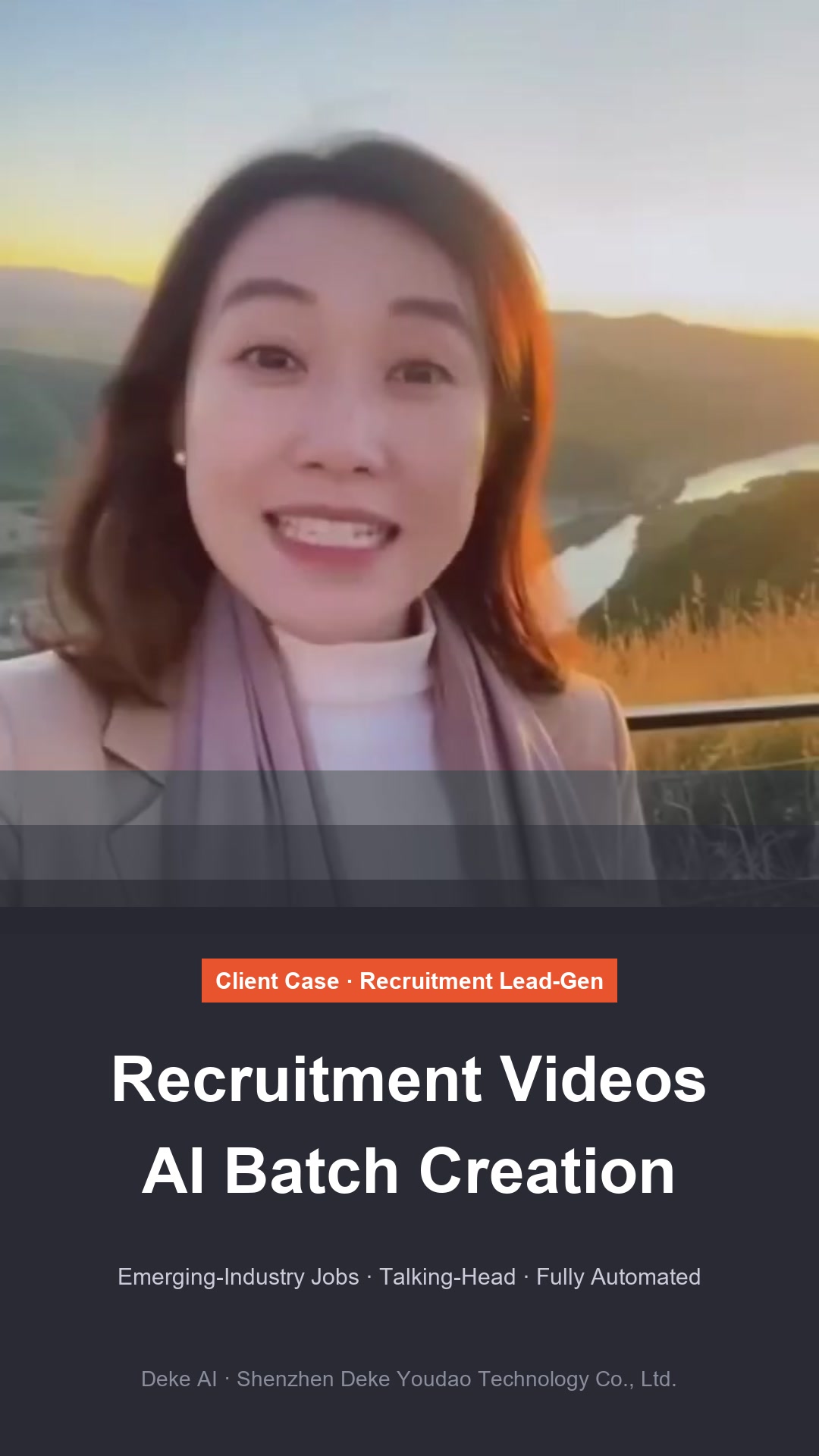
Precise Content Generation: Operators enter job information into DKS (job direction, application requirements, benefits and compensation, training method, employment destination), and the system generates a complete oral broadcast script following the structure of "present the opportunity first, then lower the threshold, then offer benefits, and finally close with the destination," producing a single vertical real-person oral broadcast video of about 53 seconds: opening with the opportunity point "future-industry jobs supported by national policy are here," using "a chance to turn things around" and "a zero-threshold entry channel specially opened" to lower the psychological threshold for applying, using "job benefits maxed out — five social insurances and one housing fund, paid training, housing subsidies" to make compensation tangible, then using "open to fresh graduates, aged 19–35, no major restrictions" to clarify application requirements, using "industry-university-research joint practical training, corporate mentors teaching hands-on" to address the concern of "can I actually learn it," and finally closing with the employment outcome of "matching with state-owned enterprises and high-tech companies upon completion, with broad development space."
Script Model Switching: Apply multiple script templates for the recruitment / employment services industry, and mass-produce the same position from different angles to ensure content is not repetitive.